Descent into the Depths

Wandar - Tiefe Erde
There is something ancient in the idea of descending into darkness.
Dante had to pass through the circles of Hell. Orpheus descended into the underworld in search of Eurydice. Odin sacrificed himself upon Yggdrasil to obtain the secret of the Runes. Across different mythologies, the descent is rarely a simple movement downward. It is a passage into what lies beneath the visible world: death, memory, fear, desire, and ultimately the self.
Wandar’s Tiefe Erde begins from precisely this point.
Released in 2026, the album completes a cycle that the German band began years ago with Landlose Ufer and continued through Zyklus. Yet Tiefe Erde feels less like another chapter than the final descent into everything those earlier records had been approaching. Wandar does not take us somewhere new. They take us deeper.
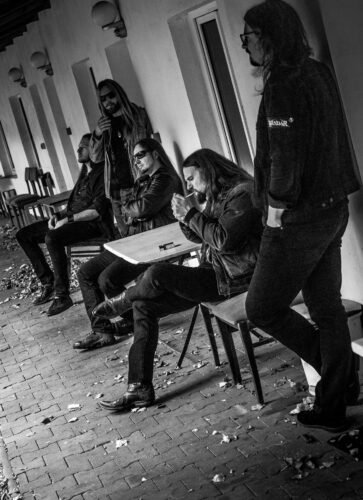
Wandar have always been interested in more than the conventional imagery of black metal. Their music has drawn from nature, mythology, literature, death, and the darker territories of human experience. Even Zyklus revealed a band willing to bring together seemingly distant worlds: the atmosphere of Scandinavian black metal, folklore, classical music, and literary voices such as Charles Baudelaire and Stephen Crane.
With Tiefe Erde, those elements become more concentrated.
The album is built around descent. Its nine tracks form a continuous passage through increasingly oppressive spaces, and the connection to Dante is difficult to miss. The nine-song structure evokes the nine circles of Inferno, while the lyrics and imagery repeatedly return to darkness, suffering, deception, death, and the search for something hidden beneath the surface.
But Wandar are not interested in retelling Dante.
The underworld here is psychological as much as mythical. It is the territory of solitude, despair, memory, and the struggle to find meaning when the world seems to have lost its guarantees.
That is what makes the album’s darkness compelling. It is not darkness for its own sake. It is darkness as a condition of experience.
Tiefe Erde is not an album that gives everything away on first listen.
Its compositions unfold gradually, allowing riffs to establish themselves before transforming into something more aggressive, more melancholic, or more restrained. The instrumental pieces, particularly “Bedrängnis”, “…Nächtlich”, and “Irrlicht”, function almost like thresholds between different stages of the journey. They interrupt the narrative without breaking it, giving the listener enough space to absorb what has already happened before moving deeper.
This pacing is essential to the record.

Wandar are not chasing immediacy. The album rarely relies on the kind of instant hooks that make a song memorable after a single listen. Instead, its strongest moments emerge through accumulation: a melody returning in another form, a riff becoming heavier through repetition, a vocal passage suddenly appearing above a dense instrumental landscape.
There is a deliberate sense of restraint here.
Even when the guitars become more aggressive, the music rarely feels uncontrolled. Compared with the rawer tendencies of earlier black metal, Tiefe Erde sounds earthy, measured, and carefully constructed. The production allows the different layers to coexist without reducing the music to clinical precision.
The result is an album that rewards active listening. It is difficult to imagine Tiefe Erde working as background music. It asks for attention, patience, and ideally several journeys through the same landscape.
The lyrics are where the album’s descent becomes most intimate.
In “Gestirne”, Wandar write:
|
Ich bin gebrochen, ich breche, bin erlegen I am broken, I break, I have fallen. |
 |
There is something particularly powerful in the phrase “the blood of the self.”
The body, identity, and consciousness begin to dissolve into one another. The speaker is no longer standing outside the darkness and observing it. He has become part of it.
This is one of the album’s central movements: the gradual collapse of distance between the observer and what is being observed.
The further the journey proceeds, the less stable the distinction becomes between the world outside and the darkness within. Deception and truth begin to overlap. Desire turns against itself. Solitude becomes both punishment and refuge.
And then, after everything has descended into darkness, the album arrives at its final question:
Ist Tiefe zu dunkel?
Is the depth too dark?
It is a remarkably simple ending for such a dense record. There is no definitive answer. The question remains suspended between despair and revelation.
Perhaps the darkness is the destination.
Perhaps it is the price of seeing.
The title “Gestirne” — stars, celestial bodies — is particularly striking because of where it appears.
After an album dominated by earth, darkness, suffering, and descent, the stars introduce another direction without necessarily offering salvation. They remain distant. The listener can look toward them, but there is no promise that they can be reached.
This ambiguity is one of Wandar’s greatest strengths.
Tiefe Erde never turns its darkness into a simple philosophy of hopelessness. There are moments where something resembling transcendence appears, but the album refuses to explain what that transcendence means. Hope is present only as a possibility, almost buried beneath everything that came before it.
That makes the final track, at nearly thirteen minutes, feel less like a conclusion than a final confrontation.
The journey may be ending, but the question remains unresolved: has the descent led somewhere beyond darkness, or has it simply revealed how deep darkness actually goes?
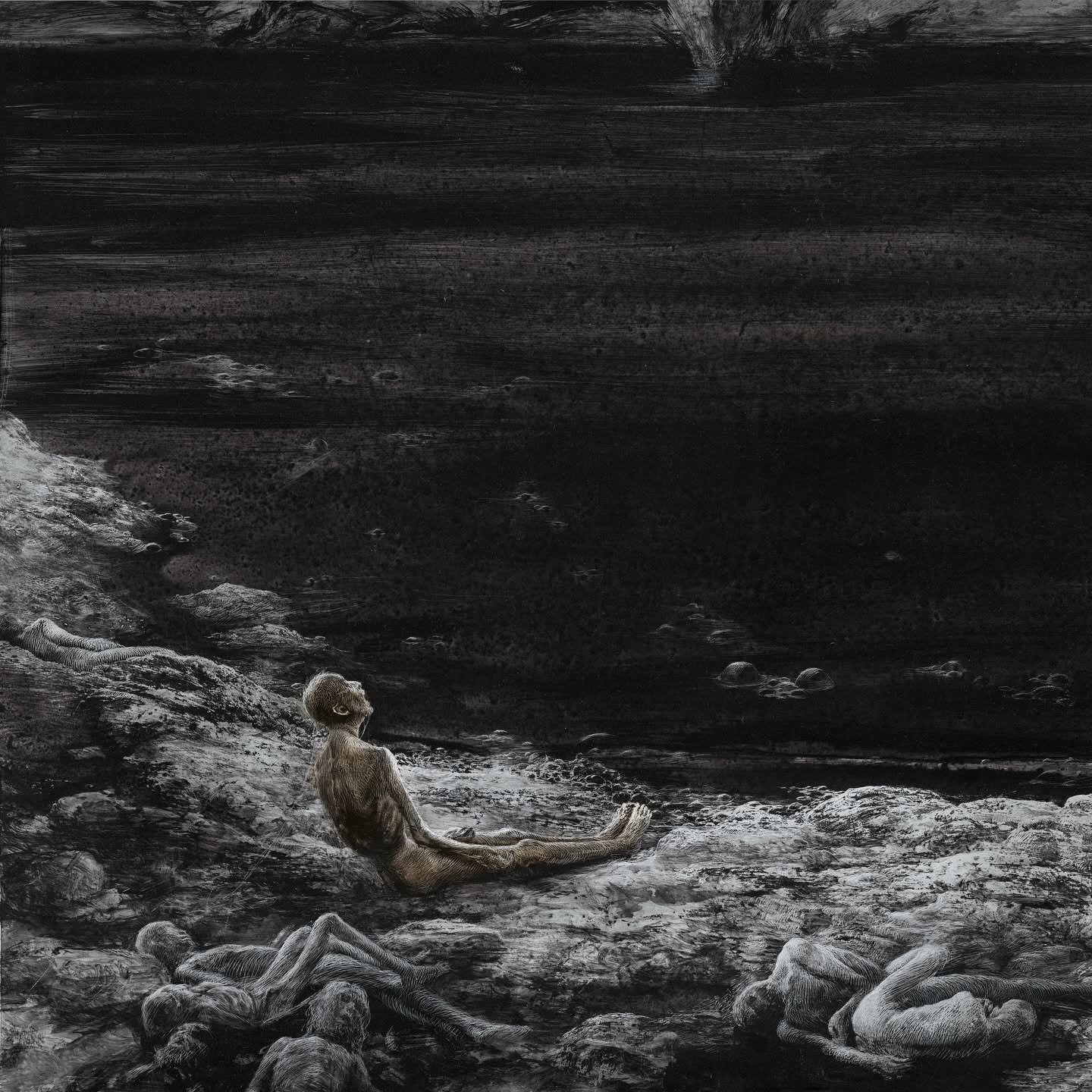
The cover artwork by Santiago Caruso completes this atmosphere with remarkable precision.
Caruso’s work has long existed in the territory between the literary, the grotesque, the mystical, and the dreamlike. For Tiefe Erde, the imagery does not function as decoration placed around the music. It feels like another entrance into the same world.
There is a sense of desolation in the image, but also of surrender. The human figure seems stripped of the ordinary protections of identity, standing within a landscape where individuality itself begins to lose its certainty.
It mirrors the album’s central idea: the deeper you descend, the less useful the familiar boundaries become.
The self, the body, the earth, the night, memory, and death begin to occupy the same space.
There is also something interesting in reading Tiefe Erde alongside older traditions of descent and transformation.
Iranian mythology, Norse mythology, Greek myth, and Christian literature all contain their own forms of passage through darkness. The details are radically different, but the underlying structure can sometimes be surprisingly familiar: knowledge is not always obtained by remaining in the light. Sometimes one has to enter the place that frightens us.
This comparison does not suggest that Wandar are drawing directly from Iranian or Zoroastrian thought. Rather, it shows how deeply rooted the idea of descent as a path toward knowledge is within human mythology.
And this is perhaps where Tiefe Erde ultimately finds its strongest identity.
It is not simply an album about darkness.
It is an album about what darkness reveals.
There are, of course, moments when Tiefe Erde demands more patience than some listeners may be willing to give. Its long compositions, restrained development, and refusal to constantly provide immediate climaxes can make the album feel distant at first.
But that distance is part of its character.
Wandar are not trying to impress the listener with technical excess or relentless aggression. Their ambition lies elsewhere: in atmosphere, structure, imagery, and the gradual transformation of a musical journey into something almost ritualistic.
Tiefe Erde completes the circle begun with Landlose Ufer and Zyklus, but completion does not mean resolution.
The earth remains deep.
The stars remain distant.
And somewhere between the two, Wandar leave us with a question that is far more unsettling than any definitive answer:
Is the depth too dark?
Bandcamp | Instagram | Vendetta Records
